
Cangzhou Spiral Steel Pipes Group Co.ltd
The Solid Foundation for Project SuccessEN 10219 Pipe Pile
BS EN 10219 Steel Pipe Piles — Supplied by Cangzhou Spiral Welded Pipe Manufacturing Group
BS EN 10219 steel pipe piles are cold-formed, welded hollow-section products used for foundation piling in the European structural engineering sector. This standard consists of three parts: EN 10219-1 specifies technical delivery conditions; EN 10219-2 specifies dimensions, tolerances, and cross-sectional properties; and EN 10219-3 covers design rules. When specifying steel pipe pile materials for European projects, EN 10219 is typically the standard of choice because it covers strength, toughness, and weldability requirements.
You should pay particular attention to the difference between EN 10219 and ASTM A252: EN 10219 explicitly requires impact toughness testing (e.g., S355J2H must meet 27 J at -20°C), whereas ASTM A252 does not require impact testing. If you are using steel pipe piles in cold climates or marine environments, this difference will directly affect the piles’ resistance to brittle fracture. Additionally, products conforming to EN 10219 must comply with the EU Construction Products Regulation (CPR) and require CE marking and a Declaration of Performance (DoP).
Cangzhou Spiral Welded Pipe Manufacturing Group specializes in the spiral submerged arc welding (SSAW) process and manufactures large-diameter steel pipe piles that meet the dimensional tolerance requirements of EN 10219-2. If you are looking for a supplier with full EN 10204 certification and third-party inspection support, please contact us directly to obtain technical specifications.
Steel Grades and Material Data
Available Steel Grades
BS EN 10219 covers a range of steel grades from S235 to S460, with the S275 and S355 series being the most commonly used in pile foundation projects. S355J2H is the most popular grade in European pile foundation projects because it maintains an impact toughness of 27J even at -20°C, making it suitable for foundation engineering in ports, offshore wind farms, and cold regions.
| Steel Grade | Minimum Yield Strength (MPa) | Tensile Strength (MPa) | Impact Test Temperature | Typical Applications |
| S235JRH | 235 | 360-510 | Room temperature | Light-Load Pile Foundations, Temporary Structures |
| S275J0H | 275 | 410-560 | 0°C | Conventional Building Foundations |
| S275J2H | 275 | 410-560 | -20°C | Basics of Cold Regions |
S355J0H | 355 | 470-630 | 0°C | Bridges, Ports |
S355J2H | 355 | 470-630 | -20°C | Heavy-Load Pile Foundations, Offshore Structures |
S355K2H | 355 | 470-630 | -30°C | Extremely Cold Environments |
Chemical Composition (using S355J2H as an example)
Elements | C Maximum | Mn Max | P Max | S (Max) | Si Max |
Content (%) | 0.22 | 1.60 | 0.030 | 0.030 | 0.55 |
The carbon equivalent (CEV) must be kept below 0.45% to ensure weldability in the field. | |||||
Mechanical Properties
The yield strength of S355J2H is classified by wall thickness: 355 MPa for wall thicknesses ≤ 16 mm, and 345 MPa for wall thicknesses between 16 and 40 mm. The tensile strength ranges from 470 to 630 MPa, with a minimum elongation of 18%. In impact testing at -20°C, the minimum absorbed energy is 27 J.
If you need a complete material data sheet for a specific steel grade, please feel free to request a technical data sheet.
BS EN 10219 Steel Pipe Pile Dimensions and Specifications
Available Size Range
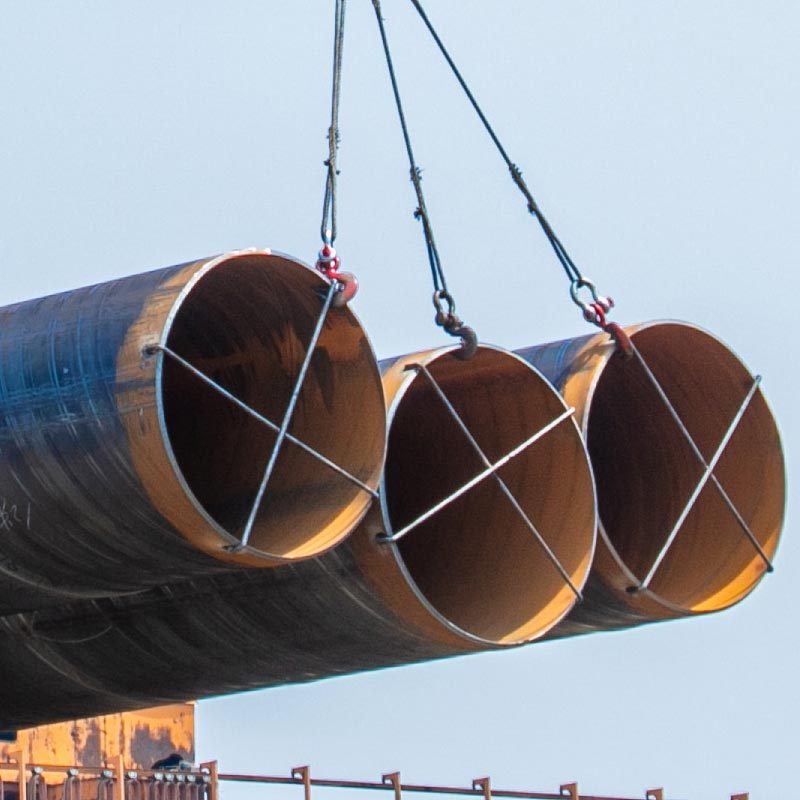
BS EN 10219-2 specifies that cold-formed welded round tubes have a maximum outer diameter of 2,500 mm and a maximum wall thickness of 40 mm. Cangzhou Spiral Welded Pipe Manufacturing Group’s production capacity covers the core range within this specification:
| Parameters | Scope |
| Outer Diameter (OD) | Φ219 – 3620 mm |
| Wall Thickness (WT) | 6 – 25.4 mm |
| Length | 1–30 m (customizable) |
Cross-Section Type | Circle Hollow Section(CHS) |
Dimensional Tolerances (EN 10219-2)
| Parameters | Permissible Tolerance |
| Outer Diameter | ±1% |
| Wall Thickness (WT) | ±12% |
| Weight | +15% / -5% Theoretical Weight |
Length | By SRL, DRL, or fixed length |
Length specifications include single random length (SRL), double random length (DRL), and fixed lengths of 6 m, 9 m, and 12 m, or custom lengths based on project requirements. | |
Caliber Categories and Application Guide
| Caliber and Gear Range | Outer Diameter Range | Typical Wall Thickness | Applicable Scenarios |
| Small-caliber | Φ219-610mm | 6-16mm | Building Foundations, Excavation Shoring |
| Medium-caliber | Φ610-1200mm | 10-20mm | Bridge Piers and Foundations, Port Structures |
| Large-diameter | Φ1200–3620 mm | 14-25.4mm | Offshore Wind Power, Heavy-Lift Terminals |
You can select the appropriate diameter based on the design load and geological conditions. If you are unsure about which model to choose, please submit your project parameters, and our engineering team will provide you with recommendations. | |||
Manufacturing Process
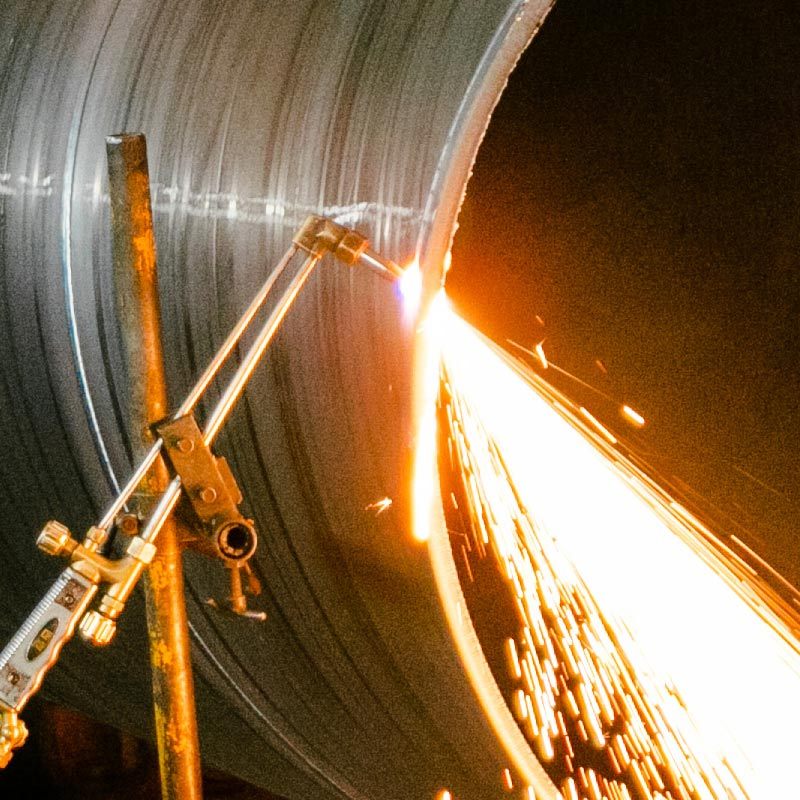
Cangzhou Spiral Welded Pipe Manufacturing Group uses the Spiral Submerged Arc Welding (SSAW) process to produce EN 10219 steel pipe piles. This process uses hot-rolled steel strip as raw material, which is spiral-formed and then subjected to double-sided submerged arc welding, resulting in a spiral weld. The SSAW process is particularly suitable for producing large-diameter, thick-walled steel pipe piles and is the standard manufacturing method for large-diameter requirements in pile foundation projects.
Compared to straight-seam welding, spiral-welded pipes feature a more uniform weld distribution and superior resistance to hoop stress. The welds on every steel pipe pile undergo 100% ultrasonic testing (UT) to ensure that weld quality meets the requirements of EN 10219-1.
Our 13 spiral steel pipe production lines and 4 anti-corrosion and thermal insulation production lines enable us to provide you with an integrated supply chain, from pile pipe manufacturing to coating. If you would like to learn more about the detailed quality control processes for the SSAW process, click here to view the production process.
Testing and Quality Assurance
Material Analysis
Melt Analysis: Maximum phosphorus (P) content: 0.030%; maximum sulfur (S) content: 0.030%. The results of the melt analysis must be reported to the customer in the MTC (Material Test Certificate).
Product Analysis: The frequency of testing is determined by the pipe diameter and order quantity.
Tensile Test
Tensile properties must meet the yield strength and tensile strength requirements for the corresponding steel grade. Note: If the yield point is not clearly defined, the yield strength corresponding to a 0.2% permanent deformation of the gauge length should be tested, or the total elongation at 0.5% of the gauge length should be tested under load.
Impact Test
For J2H and K2H steel grades, a Charpy V-notch impact test must be conducted at the specified temperature, with a minimum absorbed energy of 27 J. This is one of the key requirements that distinguishes EN 10219 from ASTM A252.
Non-Destructive Testing
Welds must undergo 100% ultrasonic testing (UT), in accordance with EN 10246 or the standards specified for the project.
EN 10204 Certificate
We provide EN 10204 3.1 or 3.2 material certificates:
| Certificate Type | Issuing Party | Testing Fundamentals | Retroactivity |
| 3.1 | Manufacturer's Authorized Representative | Specific Tests for the Actual Delivered Product | Complete Batch Number Traceability |
| 3.2 | Manufacturer + Independent Testing Agency | Specific Testing + Third-Party Witnessing | Complete Batch Number Traceability + TPI Signature |
For nuclear power plants, subsea pipelines, or critical infrastructure projects, a 3.2 certificate is a standard requirement; testing must be witnessed and jointly signed by a third-party inspection body (such as SGS, BV, or TÜV).
Defect Tolerance Limits
Surface imperfections deeper than 25% of the nominal wall thickness are considered defects. Defects no deeper than 22.5% may be repaired by welding. They must be completely removed prior to butt welding.
Coatings and Corrosion Protection
In marine and port environments, the external coating is a key factor determining the durability of steel pipe piles. We offer the following coating systems:
| Coating Types | Standards | Coating Thickness | Service Life | Applicable Scenarios |
| 3LPE | ISO 21809-1 / DIN 30670 | 2.5-3.5mm | 50+ years | Marine, Underwater, Corrosive Soil |
| FBE | AWWA C213 / ISO 21809-1 | 300-450μm | 30–50 years | Splash Zone, Atmospheric Exposure |
| Hot-dip galvanizing | ASTM A123 / ISO 1461 | 85-120μm | 20–40 years | Atmospheric exposure, land |
Key Note: For FBE coatings on long piles (12–36 m), mechanical spraying must be used instead of manual brushing. Manual brushing can cause sagging and uneven thickness, leading to coating failure. Our factory’s mechanical spraying system ensures a uniform coating of 300–450 μm and undergoes 100% leak testing.
If you are unsure which coating to select for your project, contact our coating engineers for advice.
Use Cases
BS EN 10219 steel pipe piles are widely used in the following fields:
Ports and marine structures: docks, breakwaters, seawalls, and mooring post foundations. The marine environment requires a 3LPE coating and S355J2H steel grade to ensure a service life of more than 50 years.
Bridge foundations: piers and abutments that bear dynamic and eccentric loads.
Offshore wind power: monopile foundations and jacket foundations, requiring high strength and low-temperature toughness.
Building Foundations: Foundation piles for high-rise buildings and industrial facilities.
Excavation Shoring: Temporary or permanent retaining structures that can be combined with the CT method to form continuous steel walls.
Products from Cangzhou Spiral Welded Pipe Manufacturing Group have been used in national-level projects such as the Three Gorges Dam on the Yangtze River, the West-to-East Gas Pipeline, the South-to-North Water Diversion Project, and the Daya Bay Nuclear Power Plant. If you have similar project needs, click here to view our project case studies.
Installation and Engineering Support
Pile-tip conditions
You can choose between open-ended piles and closed-ended piles. Open-ended piles form a soil plug during driving, while closed-ended piles provide a larger end-bearing area. The choice of pile cap depends on the geological conditions and load-bearing capacity requirements.
Piling Methods
| Methods | Applicable Scenarios | Features |
| Impact Piling | Dense sand layers, hard clay | High load capacity; requires PDA monitoring |
| Vibratory Piling | Sand layers, soft soil | Fast and quiet |
| Static Pressure | Urban Areas, Sensitive Environments | No vibration, but the equipment is expensive |
Penetrability Analysis
For deep foundation projects, we recommend conducting a WEAP (Wave Equation Analysis) to verify the suitability of the pile driver and estimate pile driving stresses. For critical projects, a PDA (Pile Driving Analyzer) can be used during the pile driving process to monitor bearing capacity.
Our engineering team can assist you with drivability tests and buckling analysis. If you need technical support, please schedule an engineering consultation.
Supply Chain and Services
Production Capacity
Cangzhou Spiral Welded Pipe Manufacturing Group operates 13 spiral welded pipe production lines, with an annual production capacity of 400,000 metric tons. Our products have been exported to Iraq, South Africa, Sudan, and many other countries.
| Project | Parameters |
| Outer Diameter | Φ219 – 3,620 mm |
| Wall Thickness | 6 – 25.4 mm |
| Length | 1–30 m (customizable) |
Annual production capacity | 400,000 metric tons |
One-Stop Solution
We offer a complete supply solution ranging from pile pipe manufacturing and coating to pile caps and couplings. For large-diameter steel pipe piles, we can arrange bulk shipping and long-pile splicing services.
Delivery Commitment
For European projects, we understand the pressures related to quotas and project deadlines. The lead time for standard products is typically 30–45 days, depending on the order size and coating requirements. If you have urgent project needs, please contact us to confirm the lead time.
Purchasing Guide
Information to Confirm Before Purchasing
Before placing an order, please confirm the following information:
| Project | Information You Need to Provide |
| Quantity | Meters, number of units, or metric tons |
| Material Standards | BS EN 10219-1 |
| Steel Grade | S275J0H / S355J2H, etc. |
Dimensions | Outer Diameter + Wall Thickness |
Length | SRL, DRL, or Cut-to-Length |
End Type | Beveled or flat end |
Coating | 3LPE / FBE / Hot-dip galvanized |
Certificate | EN 10204 3.1 or 3.2 |
Inspection | Is TPI verification required |
Common Procurement Misconceptions
Misconception 1: Substituting ASTM A252 for EN 10219. ASTM A252 does not require impact testing; if your project is located in a cold region or requires a guarantee of toughness, this substitution may pose a safety hazard.
Misconception 2: Ignoring the compatibility between the coating and the driving process. The 3LPE coating is designed to withstand mechanical damage during the driving process; the coating thickness and adhesion must meet the specified requirements.
If you need the full version of the procurement guide, download the procurement checklist.
Get a Quote
Ready to source BS EN 10219 steel pipe piles for your project? Click to request a quote, and our team will respond within 24 hours.
Need technical specifications or material data sheets? Request technical documentation.
Have questions about engineering selection? Schedule an engineering consultation, and our engineers will provide you with drivability analysis and coating recommendations.
Cangzhou Spiral Welded Pipe Manufacturing Group — Specializing in spiral welded pipe manufacturing, serving pile foundation projects worldwide.
0 results
ViewShowcase
FAQ
Q1: What is the difference between BS EN 10219 steel pipe piles and ASTM A252 steel pipe piles?
EN 10219 requires an impact toughness test (e.g., 27 J for S355J2H at -20°C), whereas ASTM A252 does not. EN 10219 is a European structural engineering standard that requires CE marking; ASTM A252 is a U.S. standard for pile foundations. If your project is in Europe or requires low-temperature toughness, you should choose EN 10219.
Q2: What is the difference between S355J2H and S355J0H?
The main difference lies in the impact test temperature. The J0H is tested at 0°C, while the J2H is tested at -20°C. If your project is in a cold climate or a marine environment, you should choose the J2H.
Q3: Can you manufacture EN 10219 steel pipe piles with the largest diameter?
Yes. Our SSAW production line can manufacture steel pipes ranging from Φ219 to 3620 mm, covering the maximum diameter range specified in EN 10219-2.
Q4: What is the difference between EN 10204 3.1 and 3.2 certificates?
3.1 The certificate is issued by the manufacturer and includes test results for the actual product delivered. 3.2 The certificate must also be witnessed by an independent inspection agency during testing and co-signed by that agency, providing a higher level of third-party assurance.
Q5: What type of coating should be used for steel pipe piles?
For marine and underwater environments, 3LPE is recommended (service life of 50+ years). For splash zones and atmospheric exposure, FBE (30–50 years) or hot-dip galvanizing (20–40 years) may be selected.
Q6: What tests need to be conducted before pile driving?
It is recommended to conduct a WEAP analysis to verify the suitability of the pile driver. For critical projects, a PDA can be used to monitor bearing capacity during the pile driving process.
Q7: What is your typical lead time?
Standard products: 30–45 days, depending on order size, coating requirements, and certificate type. 3.2 Certificates may require an additional 2–4 weeks.
Q8: Do you offer third-party testing?
Yes. We support third-party inspections by organizations such as SGS, BV, and TÜV; fees are determined based on the order size.
Q9: What is the minimum order quantity?
The minimum order quantity is determined based on specifications and coating requirements. Please contact us for a specific quote.
Q10: Do you have experience supplying products for projects in Europe?
Our products have been exported to numerous countries, and we have extensive experience in international supply and hold the necessary export certifications. If you have specific project requirements, please contact us for case studies.